Key Takeaways
- Business technology is shifting from isolated applications to connected operating environments.
- AI delivers lasting value when it is embedded in workflows and connected to accurate data and systems.
- Reliable integrations, built on stable APIs and events, should come before advanced automation.
- Observability, security and resilience become more important as more processes depend on shared platforms.
- Start with a few critical journeys, fix the friction, then automate and add intelligence step by step.
From separate tools to connected operating environments
For most of the last two decades, business technology grew one application at a time. A company bought a CRM for sales, a ticketing tool for IT, a telephony system for the contact center, a monitoring product for servers and a set of spreadsheets to hold everything together. Each tool solved a real problem. Taken together, though, they often produced a patchwork: data copied by hand between systems, customers asked to repeat themselves, and IT teams who could see individual components but not the whole service.
That model is changing. The next generation of business technology is defined less by individual applications and more by how well those applications work together. Leaders now ask a different question. Instead of "which tool should we buy for this function?", they ask "how does information, decision-making and action flow across the business, and where does it break?"
Three forces are driving this shift at the same time. Artificial intelligence has become practical enough to read, summarize, classify and respond within everyday workflows. Integration has become a standard expectation, with modern platforms exposing APIs and events rather than locking data away. And infrastructure, whether on-premises, cloud or hybrid, is increasingly managed as code and observed continuously. When these three forces combine, the result is what we describe as a connected operating environment: a business where systems share context, automate routine work and surface the right information to people at the right time.
Intelligence is moving into everyday workflows
Early enterprise AI projects were frequently standalone experiments: a chatbot on the website, a forecasting model in a data team's notebook, or a pilot that never reached production. The more durable trend is quieter. Intelligence is being embedded directly inside the workflows people already use.
Consider a few common examples:
- Customer conversations. Voice and chat bots can handle routine requests such as order status, appointment changes or payment reminders, and hand over to a human agent with a summary when the conversation needs judgment.
- Service management. Incoming tickets can be categorized, prioritized and routed automatically, with suggested resolutions drawn from past incidents and knowledge articles.
- Operations. Monitoring data can be analyzed for unusual patterns, so teams hear about a degrading disk or a failing integration before users report it.
- Internal requests. Employees can ask for access, equipment or information in plain language and have the request fulfilled or routed without filling in a long form.
In each case, the value does not come from the AI model alone. It comes from the model being connected to real data, real systems and a clear process for what happens next. A bot that cannot see a customer's account history, or an AI triage feature that cannot update the ticket queue, adds little. This is why intelligence and integration are converging: one is not very useful without the other.
It is also why the role of people is changing rather than disappearing. As routine steps are automated, human attention shifts toward exceptions, judgment calls, relationship work and improving the process itself. Well-designed systems make that handover explicit, with clear escalation paths and enough context that the person picking up the work does not have to start from scratch.
Connected systems and shared context
Connection is the foundation that makes intelligence and automation work. In practical terms, a connected environment has a few recognizable characteristics.
A shared view of the customer and the service
When a customer calls, the agent or bot should know who they are, what they bought, what tickets they have open and what happened in their last interaction. When an IT incident occurs, the service desk should see which business services depend on the affected component. Shared context reduces repeat questions, shortens resolution time and makes automation safer, because automated actions are based on accurate information.
Events, not just batch transfers
Traditional integrations often moved data overnight in large batches. Connected environments increasingly rely on events: a payment received, a ticket escalated, a call ended, a server threshold crossed. Each event can trigger downstream actions in other systems within seconds. This makes the business more responsive and reduces the gap between what systems know and what is actually happening.
Communication as part of the platform
Voice, messaging and email used to sit apart from business applications. Today, communication platforms are expected to integrate with CRM, service management and analytics, so that every conversation is logged, searchable and actionable. A contact center is no longer just a phone system; it is a data source and an execution channel for the wider business.
Getting there rarely requires replacing everything at once. In most organizations, the work is about identifying the handful of integration points that cause the most friction and connecting them properly, with well-designed APIs, consistent identifiers and clear ownership of each data set.
Automation that scales without becoming fragile
Automation is not new. Scheduled scripts, workflow engines and rule-based routing have existed for decades. What is changing is the scope and the expectations. Businesses now want automation that spans multiple systems, adapts to variation in inputs, and can be monitored and adjusted without a specialist rewriting code each time.
The risk is that automation built quickly becomes brittle. A workflow that depends on an undocumented field, a screen layout or a single person's knowledge will eventually fail, often silently. Sustainable automation tends to share a few traits:
- Clear triggers and outcomes. Every automated process should have a defined start, a defined result and a way to tell whether it succeeded.
- Observable execution. Logs, metrics and alerts should show when automations run, how long they take and when they fail.
- Human checkpoints where they matter. High-impact or irreversible actions, such as financial adjustments or account changes, benefit from approval steps or confidence thresholds.
- Versioned and tested changes. Automation logic should be treated like software, with change control, testing and the ability to roll back.
As AI agents become part of the automation toolkit, these principles become more important, not less. A system that can reason about what to do next needs guardrails, audit trails and clear limits on what it is allowed to change. We explore that distinction further in AI agents vs traditional automation.
Infrastructure, observability and security as the foundation
Intelligent, connected and automated systems all run on infrastructure. As more business processes depend on integrations and real-time events, the cost of infrastructure problems rises. A slow database, an expired certificate or a misconfigured firewall rule can now interrupt customer conversations, stall service workflows and break automations across several departments at once.
This is why infrastructure monitoring is evolving beyond basic CPU and memory checks. Teams need visibility into service health, dependencies, latency, queue depths, call quality and error rates, all mapped back to the business services they support. When an alert fires, the question should be "which customers or processes are affected?" not just "which server is busy?"
Security follows the same logic. Connected environments have more interfaces, more integrations and more automated identities, such as service accounts and API keys. Each is a potential point of exposure. Security has to be designed into applications and infrastructure from the start: strong authentication on every API, least-privilege access for automations, encrypted data in transit and at rest, secrets kept out of source code, and continuous review of what is exposed to the internet. Treating security as a final checklist item does not work when systems change weekly.
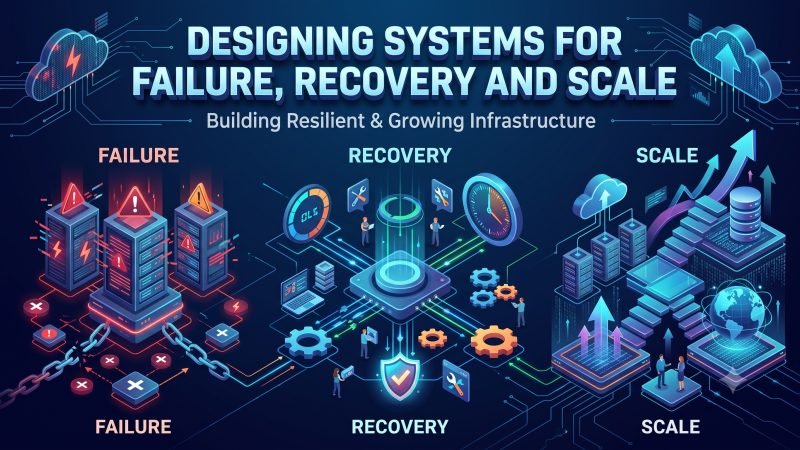
Resilience completes the picture. Backups, failover plans and tested recovery procedures matter more when many processes depend on the same platform. The goal is not to prevent every failure, which is unrealistic, but to detect problems quickly, limit their impact and recover predictably.
What business and IT leaders should do now
The move toward connected operating environments is gradual, and most organizations will run a mix of old and new systems for years. The practical question is where to start. A sensible sequence for many businesses looks like this:
- Map the critical journeys. Pick two or three end-to-end processes that matter most, such as customer onboarding, collections, IT incident handling or order fulfilment. Document every system, handoff and manual step involved.
- Find the friction. Identify where data is re-entered, where customers repeat themselves, where work waits in a queue for no good reason and where failures are discovered late.
- Fix the connections first. Before adding AI, make sure the underlying systems can share data reliably through stable APIs and events. Intelligence built on poor data produces poor outcomes.
- Automate the routine, then add intelligence. Start with predictable, high-volume tasks. Once those run reliably, introduce AI for classification, summarization, conversation handling or decision support, with clear human oversight.
- Invest in visibility. Monitoring, logging and reporting should cover the whole service, not individual parts. If you cannot see it, you cannot improve it.
- Build security and governance in. Define who owns each system and data set, what automated actors are allowed to do, and how changes are reviewed.
It also helps to choose platforms and partners that are designed for this way of working. Products that expose open APIs, support integration with existing systems and provide strong reporting are easier to fit into a connected environment than closed, all-in-one suites that assume they are the only system in use.
How Tech Rajeshwar approaches connected business technology
At Tech Rajeshwar, our work is organized around this shift. CallZenix brings AI voice bots, contact-center workflows and dialing into a platform built to integrate with the systems businesses already rely on. OZYNIX Desk provides IT service management that connects incidents, requests, assets and knowledge in one place. Around these products, we build custom software, AI agents, infrastructure monitoring and cybersecurity services that help organizations connect their systems safely and operate them with confidence.
Our view is straightforward: the future of business technology is not a single product or a single breakthrough. It is the steady work of connecting systems properly, automating what should be automated, adding intelligence where it improves outcomes, and keeping the whole environment observable and secure. Businesses that approach it that way tend to see gains that last, rather than one-off improvements that fade.
If you are planning your next step, you can explore our solutions to see how these pieces fit together for organizations at different stages.
Frequently Asked Questions
What is a connected operating environment?
It is an approach where business applications, communication channels, data and infrastructure share context and work together through integrations, so that information and actions flow across the business instead of being trapped in separate tools.
Should we adopt AI before fixing our integrations?
Usually not. AI features depend on accurate, accessible data and the ability to take action in other systems. Fixing core integrations first makes AI more useful and reduces the risk of automated decisions based on incomplete information.
Do we need to replace our existing systems to become more connected?
In most cases, no. Many organizations make significant progress by improving integrations between existing systems, adding monitoring, and introducing automation around their most important processes, replacing systems only where they cannot be integrated reasonably.